Does an Enlarged Prostate Always Need Surgery? The Honest Medical Answer: Benign prostatic hyperplasia (BPH), also known as an enlarged prostate, is a common condition affecting men as they age. The prostate gland naturally enlarges over time, which can compress the urethra and interfere with the flow of urine, leading to bothersome lower urinary tract symptoms (LUTS) such as weak urine stream, urgency, frequency, nocturia (waking at night to urinate), and incomplete bladder emptying. Not all men with an enlarged prostate require surgery — in fact, many can be effectively managed with non-surgical treatments. Understanding when surgery becomes necessary versus when conservative management is appropriate is key to optimal patient care.

In this comprehensive article, we explore the medical decision-making process behind prostate enlargement treatment, examine current evidence and guidelines, review surgical versus non-surgical options, and highlight when surgery is a proven benefit. We also discuss the importance of individualized care and the expertise required for managing these cases effectively.
Understanding Prostate Enlargement (BPH)
BPH is a non-cancerous enlargement of the prostate gland that typically occurs with advancing age. It is the most common benign prostate condition in men, with symptoms affecting up to 50% of men by age 60 and nearly 90% by age 85.
The symptoms of BPH arise primarily from the enlarged prostate compressing the urethra and bladder outlet, leading to:
- Weak or intermittent urine stream
- Difficulty initiating urination
- Frequent urination, especially at night
- Urgency to urinate
- Incomplete bladder emptying
- Occasional urinary incontinence or infections
Importantly, the size of the prostate does not always correlate with symptom severity — some men with significantly enlarged prostates may have mild symptoms, while others with modest enlargement experience severe LUTS.
Initial Approach: When Surgery Is Not Required
1. Watchful Waiting
Many men with mild symptoms that do not significantly interfere with daily activities can be managed with a strategy called watchful waiting. This includes regular monitoring of symptoms and prostate health without immediate medical or surgical intervention, especially if symptoms remain stable.
2. Medical Management
For men with mild to moderate LUTS, medical therapy remains the first-line treatment. Current pharmacologic options include:
- Alpha-blockers (e.g., tamsulosin) — relax smooth muscle of the prostate and bladder neck
- 5-alpha-reductase inhibitors (e.g., finasteride) — can shrink prostate tissue over time
- Combination therapy — used when single drugs are insufficient
- Emerging agents such as PDE-5 inhibitors and beta-3 agonists may provide additional symptom relief in select patients
Medical therapy has been shown to significantly improve symptoms in many men and may delay or even prevent the need for surgery.
3. Minimally Invasive or Office-Based Procedures
Beyond medication, less invasive procedures such as microwave therapy (e.g., transurethral microwave thermotherapy), prostatic urethral lifts (UroLift), and other novel techniques can be considered in appropriately selected patients. These options often aim to relieve obstruction without the need for traditional surgery.
When Surgery Is Recommended — Evidence and Indications
While many men do well without surgery, enlarged prostate itself is not a universal indication for surgical treatment. Surgery is recommended when there are significant symptoms or complications that affect quality of life or pose health risks.
1. Failure of Medical Management
According to guideline recommendations, surgery should be offered to men with moderate-to-severe LUTS who have failed to achieve adequate symptom relief with medical therapy or who choose not to continue medication.
2. Acute Urinary Retention
A sudden inability to urinate (acute urinary retention) is a urological emergency. When catheter removal fails despite medical therapy, surgical decompression is typically required.
3. Recurrent Urinary Tract Infections
Recurrent UTIs due to incomplete bladder emptying or stored residual urine can be an indication for surgery, particularly if infections do not resolve with conservative measures.
4. Recurrent Gross Hematuria
Persistent or recurrent blood in the urine (hematuria) resulting from prostate enlargement may require surgical intervention when conservative treatments are ineffective.
5. Bladder Stones and Obstructive Complications
Bladder stones, chronic bladder changes (such as significant trabeculation or diverticula), and signs of obstructive uropathy (e.g., hydronephrosis) may necessitate surgery to restore normal urinary flow and prevent kidney damage.
6. Renal Insufficiency Attributable to BPH
If obstruction from BPH leads to impaired kidney function, surgery is recommended to relieve the obstruction and protect renal health.
Surgical Options for BPH
Modern surgical care for BPH ranges from traditional endoscopic procedures to advanced laser techniques and minimally invasive approaches.
1. Transurethral Resection of the Prostate (TURP)
TURP remains the gold standard against which other surgical procedures are compared. It involves removing obstructive prostate tissue via a scope inserted through the urethra.
2. Laser Procedures
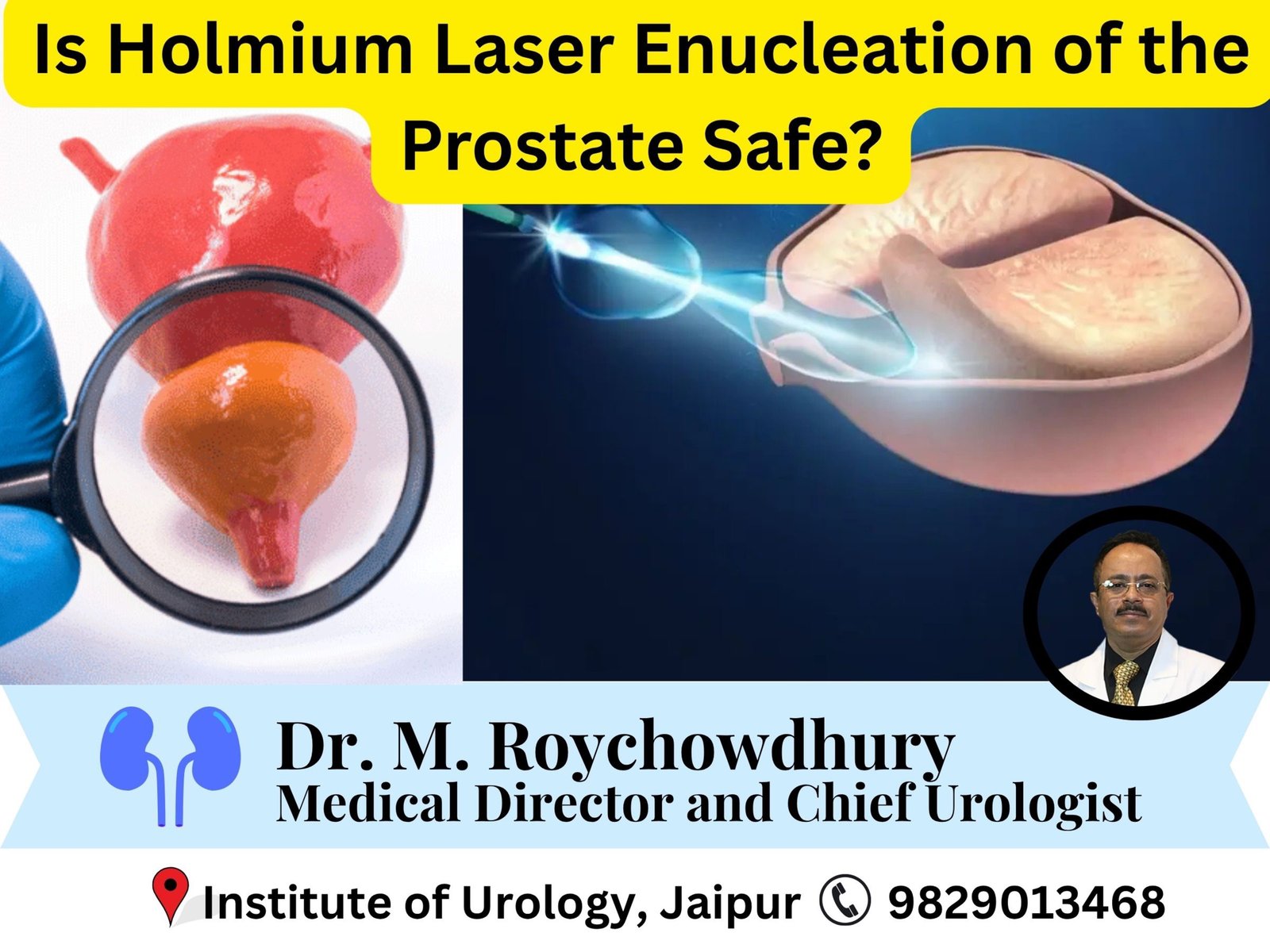
Holmium Laser Enucleation of the Prostate (HoLEP) has emerged as one of the most advanced and versatile surgical techniques for the treatment of benign prostatic hyperplasia. Unlike conventional procedures that shave or vaporize prostate tissue, HoLEP involves anatomical enucleation of the obstructing adenomatous tissue, closely mimicking open prostatectomy but through a minimally invasive endoscopic approach. This allows for complete removal of the obstructing prostate tissue, irrespective of prostate size.
One of the major advantages of HoLEP is that it is size-independent, meaning it can be safely and effectively performed in patients with small, moderate, as well as very large prostates. The use of holmium laser energy provides excellent precision and haemostasis, resulting in minimal blood loss, making it particularly suitable for elderly patients and those with comorbid conditions such as diabetes, hypertension, or those on anticoagulant therapy. Several studies have demonstrated significantly lower transfusion rates and shorter catheterization times with HoLEP compared to traditional TURP.
HoLEP is also associated with durable long-term outcomes, with very low retreatment rates, as the entire adenoma is removed rather than partially resected. Patients typically experience rapid improvement in urinary flow rates, reduction in post-void residual urine, and marked relief of lower urinary tract symptoms. Hospital stay is usually shorter, recovery is faster, and the risk of recurrence is minimal when compared to older surgical modalities.
Given these advantages, HoLEP is increasingly being considered a new gold standard for surgical management of benign prostatic enlargement, especially in centers with appropriate expertise and infrastructure. However, it is a technically demanding procedure with a steep learning curve, highlighting the importance of undergoing treatment at specialized urology centers with experienced surgeons.
3. Other Techniques
Procedures such as transurethral microwave thermotherapy (TUMT), prostatic urethral lift (UroLift), and emerging technologies (e.g., aquablation) provide additional options for very select patients, particularly those wishing to avoid more invasive surgery. However, only the urologist can assess the need of the hour.
Surgery vs. Conservative Management — What the Evidence Says
Research and clinical practice guidelines consistently emphasize individualized care. Not all enlargement causes troublesome symptoms, and many men live comfortably with mild enlargement managed conservatively. Evidence supports a stepwise approach: watchful waiting for mild symptoms, medical therapy for moderate symptoms, and surgical intervention for refractory symptoms or complications.
A single-center experience found that surgical intervention significantly improved outcomes in men with moderate-to-severe symptoms and obstruction not responsive to medications.
Importantly, the goal of treatment is to improve quality of life and prevent long-term complications rather than merely reduce prostate size alone.
Patient Factors in Decision Making
Deciding whether to proceed with surgery involves more than just symptom severity. It also includes:
- Impact on quality of life
- Patient preference and tolerance for medications
- Comorbid conditions
- Age and expected outcomes
- Risks versus benefits of surgical intervention
Shared decision-making between the patient and a specialist urologist ensures that the choice aligns with medical indications and personal values.
Conclusion: Surgery Is Not Always Required — But Sometimes Necessary
An enlarged prostate (BPH) does not always require surgery. Most men can be managed effectively with watchful waiting and medical therapy, especially those with mild to moderate symptoms. However, surgery is clearly indicated and beneficial in well-defined situations such as failed medical therapy, acute urinary retention, recurrent infections, bladder stones, and obstructive complications that put urinary or renal health at risk. Appropriate evaluation — including symptom scoring, urine testing, imaging, and specialist consultation — helps determine the best path for each individual.
Early and accurate decision-making can improve quality of life and prevent long-term complications of obstruction.
Best Hospital for Prostate Treatment in Rajasthan – Institute of Urology, Jaipur
At the Institute of Urology, Jaipur, patients receive comprehensive, patient-centric care for all urological conditions, including enlarged prostate (BPH). The institute is equipped with advanced diagnostic and therapeutic technologies, including endoscopic equipment, laser platforms, urodynamics, imaging, and surgical support — all available under one roof, along with expert general surgery consultation when needed.
Dr. M. Roychowdhury and Dr. Rajan Bansal are leading urologists with extensive experience in managing BPH and a wide range of urological disorders. Their expertise in both conservative and surgical management — including minimally invasive and advanced laser procedures — allows personalized treatment plans that maximize outcomes while minimizing risks. Their commitment to evidence-based practice and compassionate care has helped thousands of patients achieve lasting relief and improved quality of life.